

Uniform Annealing: Getting the Heat Right Where It Matters
Here’s the thing about annealing: if the heat isn’t even, your whole experiment falls apart. We built this infrared annealing system for one simple reason—to give you truly uniform heat, right where you need it. If you’ve been stuck with off-the-shelf heaters, you know the frustration. Hot spots. Cold zones. It wastes material, drags out your timeline, and makes it impossible to see what your formulation is really capable of. We approach it differently. Instead of treating power density as a fixed, unchangeable spec, we put it in your hands. You tell us your process window, and we shape the output to match it. It’s not just about the physical size; it’s about sculpting the thermal field so it lines up perfectly with the stress profile of the material you’re testing.
What’s Under the Hood: Control That Feels Intentional
At the core of this system is a high-voltage, high-density infrared platform. Running at 400V lets us pack a lot of power into a compact tube. That means serious power density without needing a massive electrical draw. The payoff? A much faster thermal response. You get a clean, sharp temperature profile right across your target zone. But there’s a catch. That kind of concentrated heat means the surrounding gear—fixtures, shielding, cooling—has to be up to the task. If you don’t plan your thermal management from the start, you’ll spend your runs chasing drift and fighting instability when you can least afford it.
Built to Take the Heat, Day After Day
We pair that electrical setup with a quartz envelope designed for fast, stable infrared output. The filament inside is arranged to give you a predictable heat pattern every time. And the tube has a special coating that manages the spectral output while shielding the element from chemical wear during repeated bake cycles. On the mechanical side, the R7s connector is the quiet hero. It locks in a solid, repeatable mount. It handles thermal expansion without throwing your alignment off. And it wires right into standard industrial fixtures. The result? It drops right into your test rigs and pilot lines like it was always meant to be there.
The Payoff: Cleaner Data, Faster Iterations
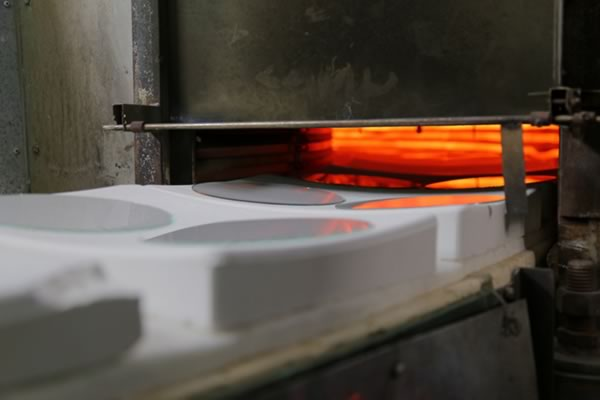
When you’re working with glass prototypes or new composites, uniform annealing is the difference between data you can trust and data that leaves you guessing. With a tailored power density map, you can run tighter thermal windows, cut down on warpage, and get repeatable results, run after run. This setup gives you real flexibility at the component level. You can tweak the power profile without having to redesign the whole oven. For engineering teams, that translates to faster iteration, less scrap, and a clearer view of how material changes actually affect thermal behavior. We provide the lamp. You set the process. That’s how R&D-grade support shows up on the bench and in pilot production—quietly, reliably, and exactly as promised.